
49 WINCHESTER
Saturday, September 19, 2026
@ Credit Union 1 Amphitheatre in Tinley Park, IL
(Review Written By: Dave Pierce)
(Photo Credit: Zach Pierce)
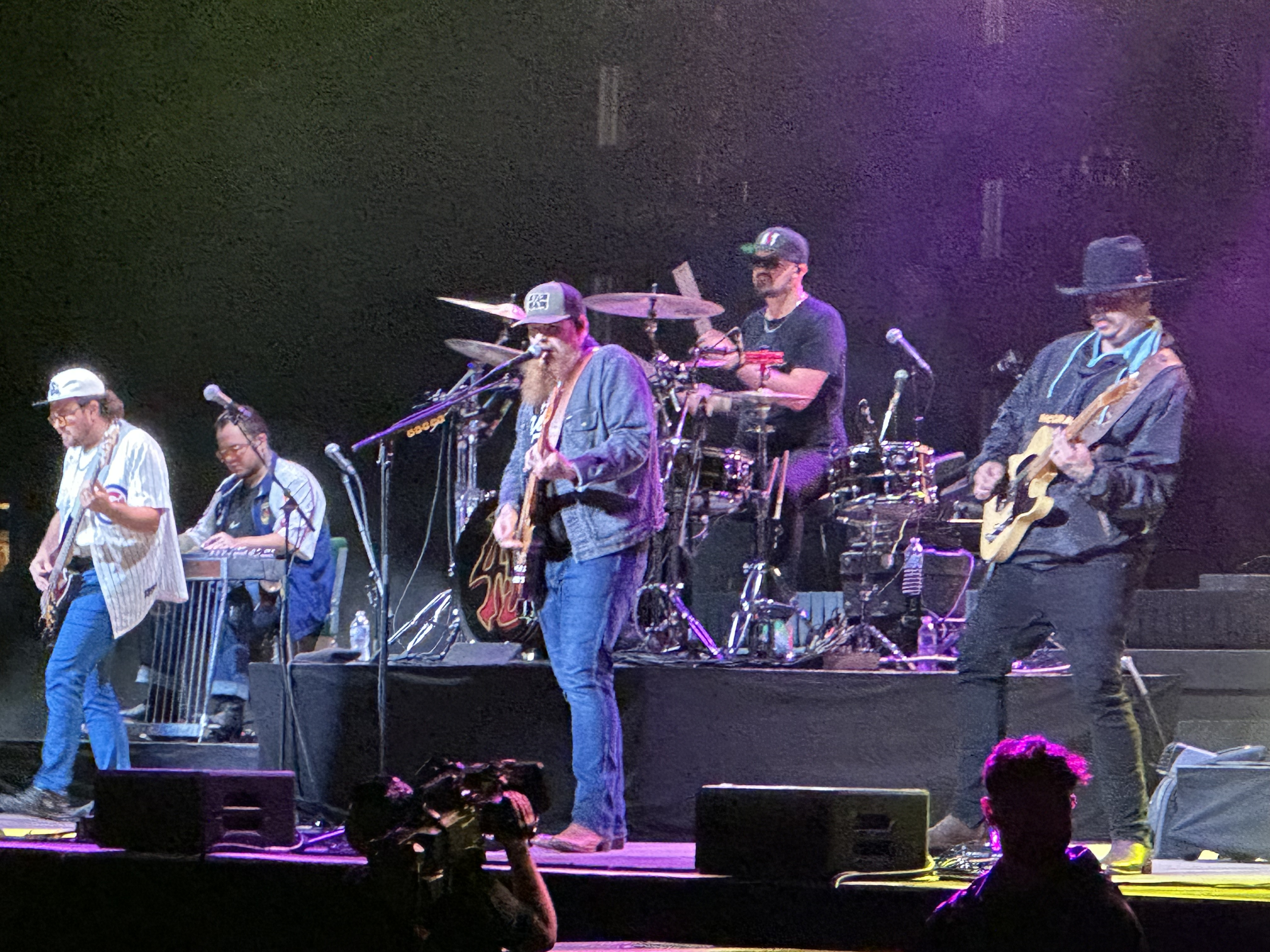
On a late-summer Saturday night in Tinley Park, 49 Winchester stepped onto the stage at Credit Union 1 Amphitheatre with the useful burden every great opener understands: win over a crowd that arrived with someone else’s name on the ticket. As support for Tim McGraw’s 2026 North American “Pawn Shop Guitar Tour,” officially promoted and produced by Live Nation, the Virginia band did not treat the assignment like a warm-up slot. They treated it like a chance to turn a sprawling amphitheater into a front-porch gathering, then steadily raised the temperature from there.
The set opened with “Bluebird,” a fitting first impression for a band whose best work carries both motion and memory. Lead singer Isaac Gibson’s voice had the grain of road miles in it from the start—big, weathered, and open-hearted—but the band around him gave the songs their lift. Guitars cut cleanly through the evening air, the rhythm section pushed without crowding, and the whole performance carried the feeling of a group built by repetition, not polish alone.
Early on, Gibson kept things simple, offering a quick “Thank you very much” before the band moved through “Hays, Kansas,” “Bringin’ Home the Bacon,” and “Pardon Me.” That humility became part of the show’s architecture. 49 Winchester did not oversell themselves; they introduced their world, song by song, and trusted the crowd to come closer.
The emotional center arrived when Gibson paused to locate the band for the Illinois audience. “We’re from southwestern Virginia,” he told the crowd. “Thank you so much for making us feel so welcome up here. We play songs about where we are from. We all came up together in a small town in Russell County. We’re gonna play a little Russell County for you now.” That sense of place is central to 49 Winchester’s identity, with the band’s story rooted in Castlewood, Virginia, Appalachian storytelling, and a long climb from hometown beginnings to major stages.
Then came “Russell County Line,” and the set seemed to deepen. It was not merely a hometown anthem dropped into an amphitheater playlist; it felt like the key that unlocked the band’s purpose. The song gave the performance its roots, and from there “Anchor,” “Everlasting Lover,” “Long Hard Life,” and “The Wind” widened the frame. Taken together, the run showed off what makes 49 Winchester such an effective live act: they can play with Southern-rock muscle, country sincerity, and soul-band conviction without making those elements feel stitched together.
Gibson’s stage presence was casually magnetic. He spoke like someone grateful to be there, not someone demanding attention, and that restraint made the bigger vocal moments land harder. Before “Slowly,” he simply said, “Thank you! This next one’s called Slowly.” The understatement worked. The song became a showcase for the band’s ability to ease back without losing intensity, letting melody and ache do the heavy lifting.
By the time Gibson introduced “Tulsa”—“Thank you so very much. We appreciate the love tonight. Next song we’re gonna play for y’all is called Tulsa and it goes like this”—the crowd had warmed noticeably. “Tulsa” and “Last Call” gave the back half of the set a lived-in looseness, the kind of barroom glory that can feel just as natural under amphitheater lights as it does in a smaller room. Even when the songs leaned into weariness, the band played with a bright, communal charge.
The night’s most human moment came near the end, when Gibson admitted, “I’ll tell you what my voice box is about to fall out of my throat, but I think I got one more song. Can I play one more song for you? Can we play an Ozzy song for you all tonight?” What followed was “Changes,” a choice that could have risked feeling like a novelty in the wrong hands. Instead, 49 Winchester played it with respect and emotional clarity, closing their set on a note that felt less like a cover than a benediction.
“Thank you, we’re 49 Winchester, enjoy the rest of the show,” Gibson said before leaving the stage. It was a modest exit after a set that had done exactly what an opening performance should do: introduce, persuade, and leave a mark. On a bill topped by one of country music’s most familiar names, 49 Winchester gave Tinley Park something distinct—a performance full of sweat, gratitude, hometown pride, and the kind of unforced authenticity that travels well beyond the county line.
Latest Updates
- Show Review: Tim McGraw Turns a Rainy Tinley Park Night into a Career-Spanning Campfire
- Show Review: 49 Winchester Bring Russell County Fire to Tinley Park
- Music Video: Mae Estes ft. Shenandoah - "Moon Over Georgia"
- Music Video: Zach John King ft. Brooks & Dunn - "Way To Go"
- Visualizer: Hudson Westbrook - "Made You Look"
- Music Video: Bryce Leatherwood - "Grain of Salt"
- Lyric Video: Ian Munsick - "Palomino Eyes"
- Music Video: Aaron Watson - "Dolly Parton Pinball Machine"
- Music Video: Chase Matthew - "Autopilot"
- #throwbackthursday: Heidi Newfield - "Johnny And June"
- Single Review: Owen Riegling - "Me Without My Hometown"
- Performance Video: Wyatt Flores - "Runnin' On E" (Live at Spotify House)
- Music Video: Avery Anna - "Blood Runs Thicker"
- Music Video: Carly Pearce & Riley Green - "If I Don't Leave I'm Gonna Stay"
- Visualizer: LOCASH - "Talkin Bout"
- Single Review: Graham Barham - "LEAVIN'" ft. Wiz Khalifa
- Single Review: Kenny Whitmire - “Woman To Blame”
- Single Review: Treaty Oak Revival & Wade Forster - “Can of Worms”
- Single Review: Luke Bryan - “I Liked Loving You”
- Single Review: Tyce Delk - “Up There Down Here”